Types of Septum Piercings: A Complete Overview
Search “types of septum piercings” and you’ll get two very different kinds of answers mixed together. Some results talk about placement — where exactly the piercing sits and what it goes through. Others talk about jewelry — the ring, barbell, or clicker sitting in that piercing. Both are legitimate answers, and neither makes much sense without the other.
This guide separates the two clearly, then layers in the gauge sizes and materials that go with them, so you walk away knowing exactly what to ask your piercer for — and why it matters more than it might seem.
Quick Summary
| Category | What It Covers | Most Common Choice |
| Placement | Where the piercing physically sits | Sweet spot (soft tissue) |
| Jewelry style | What sits in the piercing | Circular barbell |
| Gauge | Thickness of the jewelry | 16g or 14g |
| Material | What the jewelry is made of | Implant-grade titanium or surgical steel |
1. Types of Septum Piercings by Placement
There are really only two placement categories, and the difference matters more than most people realize going in.
| Type | Location | Relative Pain | Typical Healing Time | How Common |
| Standard (sweet spot) | Thin soft tissue at the front of the septum | Lower | 6–8 weeks surface, several months full | Very common |
| Cartilage | Through the septal cartilage itself | Higher | Longer than sweet-spot healing | Uncommon |
| High septum | Higher and further back than standard | Varies | Varies by depth/anatomy | Rare |
Standard (Sweet Spot) Septum Piercing
The large majority of septum piercings go through a thin strip of soft tissue at the front of the septum, often called the “sweet spot.” A piercer identifies it by gently pinching the front of your septum and feeling for where the tissue turns thin and pliable. This placement heals faster and is generally more comfortable — for a full breakdown of what that healing process looks like week by week, see our septum piercing healing and aftercare guide.
Cartilage Septum Piercing
Some people’s anatomy doesn’t leave much soft tissue to work with — the cartilage extends further forward than usual, leaving little or no sweet spot. In that case, the piercing goes through cartilage instead. This isn’t a style choice; it’s determined by anatomy, and a piercer should check this in person before you book rather than deciding on the spot.
High Septum Piercing
Placed further back and higher than a standard piercing. It’s far less common, heavily dependent on individual anatomy, and worth a longer conversation with an experienced piercer. Read more about how placement is assessed in our septum piercing placement and anatomy guide.
2. Types of Septum Piercings by Jewelry Style
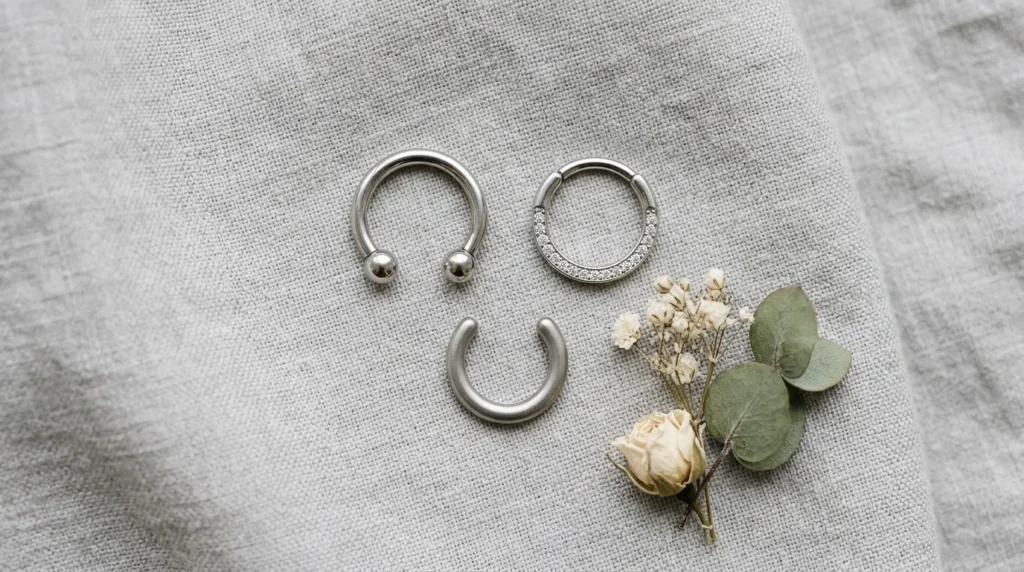
This is where most of the visual variety comes from, since the exact same piercing can look completely different depending on what’s worn in it.
| Style | Best For | Insertion Difficulty | Fresh Piercing or Healed Only |
| Circular barbell | First-time piercings, easy hiding | Easy | Fresh-piercing safe |
| Horseshoe | Easy cleaning, simple wear | Easy | Fresh-piercing safe |
| Captive bead ring | Early-to-mid healing | Moderate | Fresh-piercing safe |
| Segment/hinged ring | Everyday wear, no visible closure | Moderate | Healed only |
| Septum clicker | Decorative front designs | Moderate | Healed only |
| Seamless ring | Clean, minimal look | Harder | Healed only |
| Retainer | Concealment for work/events | Easy | Fresh-piercing safe |
| Spike / tusk barbell | Bolder aesthetic | Moderate | Healed only |
| Chain septum | Statement/festival looks | Moderate | Healed only |
| Stacked septum | Advanced, stretched piercings | Advanced | Fully healed and stretched only |
Everyday and Starter Styles
- Circular barbell — a curved bar with removable beads on each end. The most common starter style, and the easiest to flip up and hide. See our guide to hiding a septum piercing for the technique.
- Horseshoe — similar to a circular barbell but open on one side, sliding in and out rather than unscrewing.
- Captive bead ring — a hoop held closed by a single bead, adding visual interest without a clicker’s complexity.
- Retainer — a clear or low-profile piece designed to stay nearly invisible, for situations where visible jewelry isn’t an option.
Styles for Healed Piercings
- Segment or hinged ring — a full hoop with a small hinged section that opens for insertion, sitting flush once closed.
- Septum clicker — a hinged ring with a front-facing side that can carry stones or shapes without affecting how it opens.
- Seamless ring — a continuous hoop with no visible closure; trickier to insert and remove, so better suited to healed tissue.
- Spike or tusk-style barbell — a bolder, angular look with pointed ends, generally not offered as starter jewelry.
- Chain septum — a barbell or clicker with a fine chain draped between the ends. The added weight and movement can irritate fresh tissue, so this is a healed-piercing style.
- Stacked septum — multiple rings through a septum that’s been deliberately stretched over time. See our gauge size chart before considering stretching.
3. Septum Piercing Gauge Sizes Explained
Gauge determines how thick the jewelry is, and the numbering runs backward from what most people expect — a smaller number means thicker jewelry. Here’s the standard gauge-to-millimeter conversion used across the piercing industry (also available in more detail in our full septum piercing gauge size chart):
| Gauge (AWG) | Millimeters | Common Use |
| 20g | 0.8 mm | Rare for septum, more common in ear piercings |
| 18g | 1.0 mm | Occasionally used for initial piercings |
| 16g | 1.2 mm | Common standard starting gauge |
| 14g | 1.6 mm | Common standard starting gauge |
| 12g | 2.0 mm | Post-healing upsizing |
| 10g | 2.5 mm | Stretched piercings |
| 8g | 3.2 mm | Stretched piercings |
| 6g | 4.0 mm | Stretched piercings |
| 4g | 5.0 mm | Advanced stretched piercings |
| 2g | 6.0 mm | Advanced stretched piercings |
| 0g | 8.0 mm | Advanced stretched piercings |
Most studios pierce new septums at either 16g or 14g. Stretching to a thicker gauge is something to consider only after the piercing is fully healed, and it should be done gradually — one size at a time — rather than jumping several sizes at once. If you’re changing jewelry for the first time, our guide to changing septum jewelry safely walks through the timing and technique.
4. Materials Used Across Septum Jewelry Types
The type of jewelry matters less than what it’s made of, especially during healing. Lower-grade metals are one of the most common causes of irritation that gets mistaken for a “bad piercing.” For a full breakdown, see titanium vs. gold vs. surgical steel.
| Material | Hypoallergenic | Durability | Typical Price Range | Notes |
| Surgical steel | Good | High | Budget-friendly | Widely available, safe for most people |
| Implant-grade titanium | Excellent | High | Mid-range | Recommended for sensitive skin |
| Niobium | Excellent | High | Mid-range | Similar benefits to titanium |
| 14k/18k solid gold | Excellent | High | Higher-end | Premium option — confirm it’s solid, not plated |
| Plated/costume metals | Poor | Low | Cheapest | Not recommended during healing |
Industry guidance from piercing associations like the Association of Professional Piercers consistently points to implant-grade materials for new and healing piercings — this is worth asking your piercer about directly, since not every studio stocks jewelry to that standard by default.
5. Which Type Should You Start With?
If you’re getting your first septum piercing, the decision is simpler than the lists above suggest. Almost every experienced piercer will start you with a circular barbell or captive bead ring at 16g or 14g, in implant-grade titanium or surgical steel. These combinations are the easiest to fit correctly, the easiest to keep clean, and the most forgiving while tissue is still healing. See our full septum jewelry guide for more on choosing your first piece.
Save the clicker, the seamless ring, spikes, chains, and stretched styles for after healing is complete — typically several months in, not several weeks.
6. How Placement and Jewelry Type Affect Healing
The type of piercing you get changes more than the look — it changes the aftercare. A sweet-spot piercing with a simple circular barbell is the easiest combination to keep clean and the fastest to settle. A cartilage piercing, an unusually shaped piece of jewelry, or a lower-grade metal all introduce more friction or irritation risk against healing tissue. Our aftercare guide covers exactly what to expect at each stage, and our troubleshooting guide covers what to do if something feels off.
7. Styling Different Septum Piercing Types
Once you understand the placement and jewelry categories, styling becomes a question of matching the piece to the situation rather than picking blind.
- For work or formal settings: a retainer or a flipped-up circular barbell keeps things invisible — see our hiding guide for the exact technique.
- For everyday wear: a captive bead ring or segment ring gives a clean, low-maintenance look that doesn’t need much thought once it’s in.
- For a statement look: clickers, spikes, or a chain septum draw the eye — but only once the piercing is fully healed.
- For pairing with other nose jewelry: septum jewelry is commonly worn alongside a nostril stud or hoop. Fit and proportion matter more here than with a septum piece alone, so it’s worth discussing with your piercer or reviewing options in the jewelry guide.
8. Common Mistakes When Choosing a Type
- Picking a decorative style (clicker, seamless ring, spikes) as your first piece, before the tissue has had time to heal.
- Choosing jewelry based on looks alone, without checking the material — one of the more common causes of irritation mistaken for infection.
- Assuming a “high septum” or cartilage piercing is available on request, without a piercer confirming your anatomy supports it.
- Jumping multiple gauge sizes at once when stretching, instead of increasing gradually — see the gauge chart for standard sizing steps.
- Switching jewelry type before healing is actually complete internally, not just on the surface.
9. Frequently Asked Questions
Are all septum piercings pierced in the same spot?
No — most go through the soft “sweet spot” tissue, but some anatomy requires a cartilage piercing instead, which changes both the pain level and the healing timeline.
What gauge is a standard septum piercing?
Most studios start new piercings at 16g (1.2mm) or 14g (1.6mm). Thicker gauges are for stretching after full healing — see the full gauge chart.
What’s the easiest septum jewelry style to start with?
A circular barbell or captive bead ring in implant-grade titanium or surgical steel is the most common and manageable starting point.
Can I choose any jewelry style right after getting pierced?
Not immediately. Fresh piercings need starter-appropriate jewelry; more decorative or heavier styles usually wait until healing is complete.
Is a “high septum” piercing the same as a regular one?
No — it’s a different, less common placement that depends heavily on individual anatomy, and not every studio offers it.
Does jewelry material actually matter that much?
Yes. Lower-grade or plated metals are one of the more common causes of irritation mistaken for infection. See titanium vs. gold vs. surgical steel for the full comparison.
Can I wear a chain or stacked septum style right away?
No. Both are advanced looks meant for fully healed, and in the case of stacking, stretched piercings — not starter jewelry.
Where to Go Next
Ready to go deeper on jewelry itself? Our full jewelry and gauge guide covers materials, sizing, and how to choose your first piece with confidence. If you’re earlier in the process, start with our septum piercing cost breakdown or our healing and aftercare guide.